Origins
What Exactly Was a Trichy Cigar?
A documented introduction to the shape, name, materials, and changing identity of the celebrated Trichy cigar.
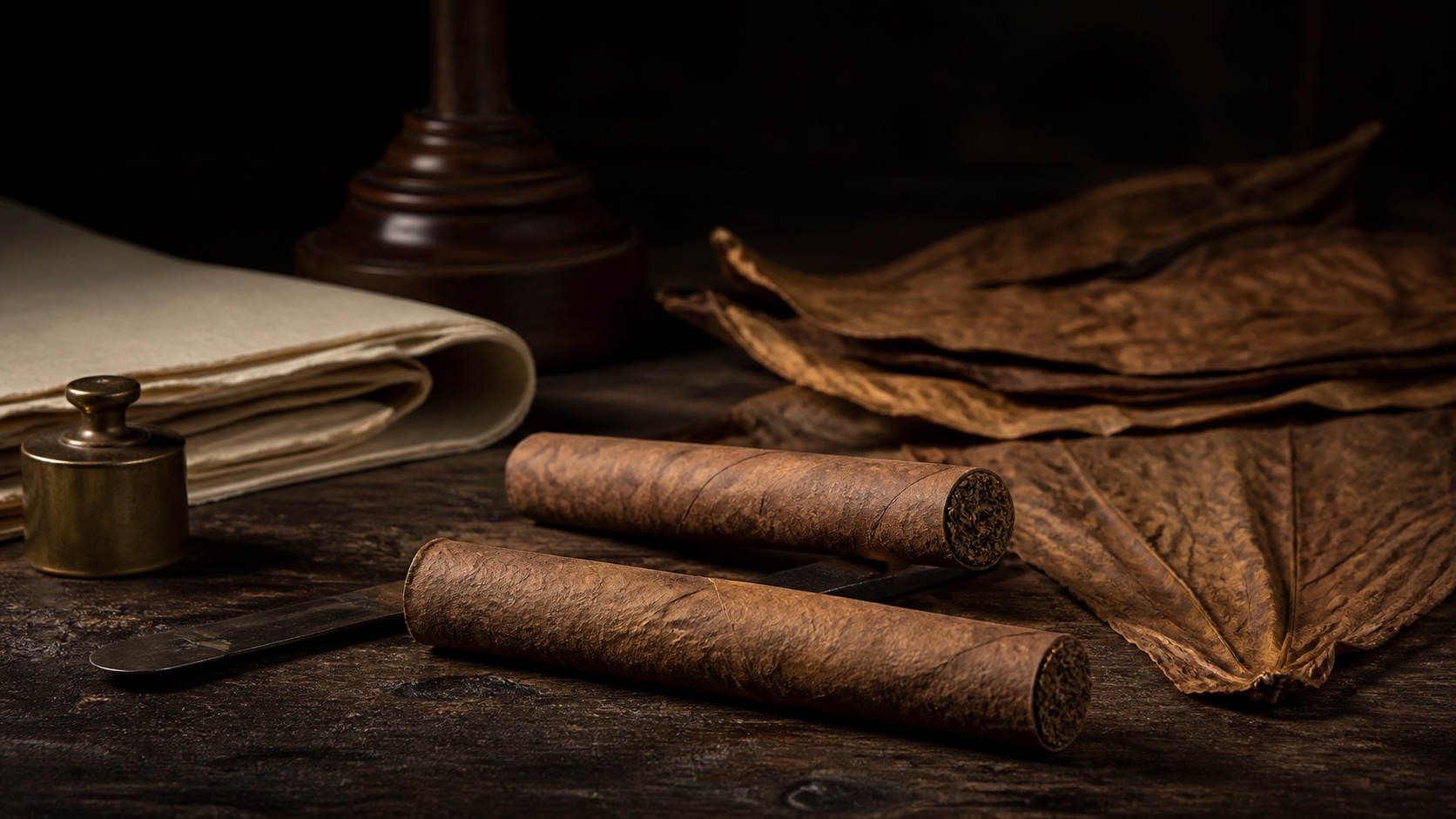
The name sounds precise: a Trichy cigar. Historical records usually call the city Trichinopoly, its former English name. In this journal, “Trichy” and “Trichinopoly” refer to the same place, today officially named Tiruchirappalli. We use “Trichy cigar” in our own voice and preserve “Trichinopoly” when discussing historical titles, quotations, and product names.
Yet the object behind the name shifted with place, quality, leaf, and period. To understand it, we need to begin with a simpler question. What made a cheroot a cheroot?
The most useful historical answer concerns its shape. The 1903 edition of Hobson-Jobson, a dictionary of words used in British India, described a cheroot as a cigar cut flat at both ends. A mid-twentieth-century Indian labour inquiry drew much the same distinction. It said cheroots generally had a single wrapping and were truncated at both ends, while higher-grade cigars commonly had more wrapping and one closed end.1
That difference sounds small. It was visible at a glance. A familiar modern cigar often narrows or closes at the head. A traditional cheroot was more nearly cylindrical, with two open, straight-cut ends. There was no fixed mouth end. This plain geometry became one of the form’s defining traits.
A Tamil word that travelled
The word itself carries the history of the object. Hobson-Jobson connected “cheroot” with the Tamil shuruṭṭu, meaning a roll of tobacco. The dictionary cited an eighteenth-century Tamil story in which a character carried a firebrand to light a roll of tobacco. It also noted that an English form of the word had been recorded even earlier, in 1669.1
One of the dictionary’s quotations adds another word to the trail. An 1810 account compared cheroots with the Spanish “segar.” Segar was an older English spelling of cigar, a word derived from the Spanish cigarro. The quotation does not prove that cheroot and cigar were identical in every construction. It shows that writers reached for several spellings and languages while trying to describe a related rolled-tobacco form.1
Spelling varied as the word moved between languages and print cultures. The object did not begin as a European cigar with an exotic name attached to it. Its English name emerged from a South Indian word for something rolled.
The same dictionary made another important observation. In southern India, it associated two major regional products with their places of manufacture: “Trichies” from Trichinopoly and “Lunkas” from the Godavari delta.1 Trichy was therefore more than a town printed on a box. It functioned as a commercial identity.
A Trichy product made from travelling leaf
Place-names can make production look tidier than it was. The 1907 Madras District Gazetteer reported that Trichinopoly city manufactured and exported about 12 million cigars a year, valued at roughly 75,000 rupees. It also stated that most of the tobacco leaf came from Dindigul, about 100 kilometres to the southwest.2
The neighbouring Madura district’s gazetteer helps explain the connection. Before the railway reached Dindigul, much of the district’s tobacco was sent to Trichinopoly, then a centre of the cheroot trade. Dindigul later developed a substantial manufacturing industry of its own.3

So what made it a Trichy cigar? The evidence points first to manufacture, trade, and reputation, not necessarily to leaf grown within the city. Trichy gathered tobacco, labour, firms, and routes into a product recognised beyond the district.
That identity changed again during the twentieth century. A Government of India labour inquiry conducted during the 1940s described Trichinopoly, Dindigul, and Madras as the main cigar-making centres in southern India. It identified Woraiyur, a suburb of Trichinopoly, and Dindigul as centres for higher-grade cigars. The same report said Indian manufacturers had used considerable quantities of Java and Sumatra tobacco before wartime disruption.4
The labour inquiry deserves an article of its own. It records factory organisation, employment, wrapper types, wartime disruption, and firms such as Spencer & Company in far more detail than we can examine here. We will return to the report in a later study of Trichy’s manufacturers, brands, and workers.
There was never just one immutable recipe called the Trichy cigar. Local skill and commercial geography remained important, but manufacturers worked with different leaves and constructions for different markets.
Cheroot or cigar?
Historical sources use the two words inconsistently. The 1907 gazetteer discussed Trichy “cigars” and “plain cheroots” within the same short account. The later labour report tried to separate the categories by wrapping, shape, price, and social market. It described cheaper single-wrapped products as cheroots and double-wrapped products as cigars.24
Those categories also carried prejudice. The labour report called the cheroot inferior and framed cigar and cheroot consumption through class. Its wording records how officials and manufacturers classified the trade in the 1940s. It should not be treated as a timeless judgement of quality.
Construction is the safer distinction. A cheroot was typically a compact roll of tobacco with straight-cut ends, often more simply wrapped than a premium cigar. “Trichy cigar,” historically marketed as the “Trichinopoly cigar,” became the broader name under which several grades and constructions could travel.
What the evidence supports
We can now give a careful answer.
A Trichy cigar was a South Indian rolled-tobacco product associated above all with manufacture and trade in Trichy, called Trichinopoly in the historical records and Tiruchirappalli officially today. Its classic cheroot form was cylindrical and open at both ends. The word cheroot was rooted in a Tamil word for a roll of tobacco. The leaf might come from Dindigul or, in some later premium production, from overseas. Its construction and quality varied.
This account is less romantic than the idea of a single secret Trichy blend. It is also more interesting. The cheroot was not merely an object. It was a network: Tamil language, regional agriculture, skilled labour, factories in and around Woraiyur, railways, merchants, and buyers who learned to recognise a city through a roll of tobacco.
The next article in this series will move from the object to the workplace and ask what historical observers recorded inside Trichy’s cigar industry.
Sources
-
Henry Yule and A. C. Burnell, “Cheroot,” Hobson-Jobson, 1903 edition. This is a colonial-era reference work and is used here for historical terminology and the citations it preserves. ↩ ↩2 ↩3 ↩4
-
F. R. Hemingway, Madras District Gazetteers: Trichinopoly, Government Press, Madras, 1907, especially the district industry account. ↩ ↩2
-
W. Francis, Madras District Gazetteers: Madura, Volume I, Government Press, Madras, 1906, section on cigar manufacture. ↩
-
Government of India Labour Investigation Committee, Report on an Enquiry into Conditions of Labour in the Bidi, Cigar and Cigarette Industries, chapter VI, pp. 43–44 in the printed report. The inquiry describes the industry during the 1940s. ↩ ↩2