Brands
Flor de Spencer and the Brands That Vanished Like Smoke
Flor de Spencer, Gold Mohur, Bahadur, Lady Love, Dawson: the surviving names reveal a Trichy cigar trade built on brands that changed across factories and markets.
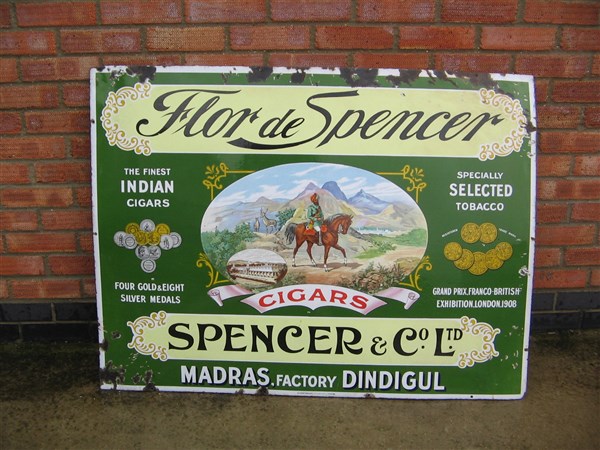
The sign is battered around its edges, but it was made to project confidence. Against a deep green field, a rider crosses a mountain landscape. Gold medals gather on either side. Large script announces Flor de Spencer. Smaller lettering promises “the finest Indian cigars” and “specially selected tobacco.” At the bottom is the manufacturer: Spencer & Co. Ltd., Madras, factory Dindigul.
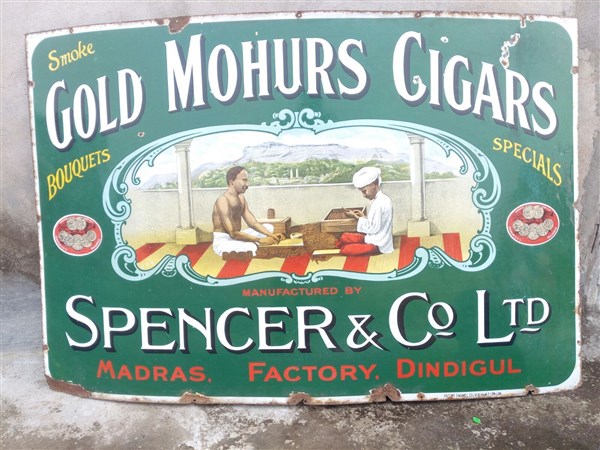
Flor de Spencer is one of the few old South Indian cigar names that has left behind such a vivid face. Another enamel sign from the same company advertises Gold Mohurs Cigars. Period newspapers add Little Randolph, Torpedo, Beaconsfield, Catamaran, Regina, and dozens more. Other manufacturers sold Bahadur, Morning Whiffs, Light of India, Lady Love, Dawson, Five Minutes, and Royal Whiffs.
These names once travelled farther than most accounts of the Trichy cigar now suggest. They appeared in catalogues, on boxes and signs, and in advertisements placed thousands of kilometres from South India. Yet many have disappeared so completely that even their makers can be difficult to identify.
The lost catalogue also presents a problem. A brand name did not always correspond to one factory or one fixed recipe. The same cigar might carry different names in different markets. A factory might register a new identity when an old brand lost its customers. To recover Trichy’s forgotten brands, we therefore need to look beyond a nostalgic roll call. We need to ask what those names were designed to do.
The house with eighty-six varieties
Spencer & Co. was much more than a cigar maker. It developed into a major Madras retailing and hospitality business, selling imported goods, provisions, wines, and other markers of colonial urban life. Its cigar enterprise began with contractors in Trichinopoly in the late nineteenth century. The operation later moved to Dindigul, closer to an important tobacco-growing district.
This movement matters. Flor de Spencer and Gold Mohur belonged to the wider commercial history of the Trichy cigar, but the signs identify Dindigul as their place of manufacture. “Trichy cigar” had become a market identity broad enough to contain leaf, labour, and factories from more than one South Indian centre.
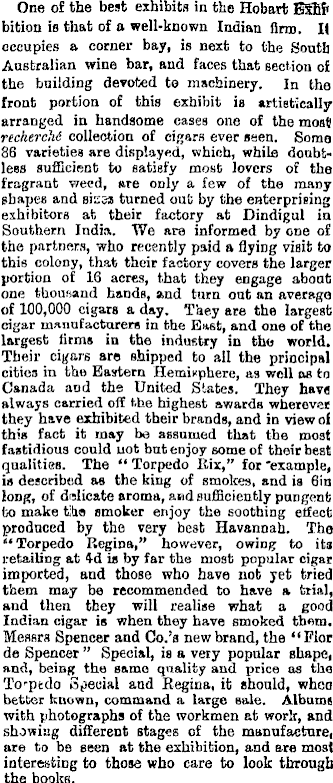
An 1895 newspaper account of an Indian display at the Hobart Exhibition gives a sense of Spencer’s range. The exhibit reportedly contained 86 cigar varieties. It named Torpedo Rex as the leading cigar, followed by Torpedo Regina. It also introduced Flor de Spencer Special and referred to Torpedo Special and Regina. The report claimed an average factory output of 100,000 cigars a day. The figures came through an exhibition report and should be read as promotional claims, but the variety of named products is unmistakable.
The names kept multiplying. In December 1908, an auction notice in Dunedin offered 300 boxes of Spencer’s Indian cigars. Its list included Beaconsfield, Torpedoes Special, Prince’s Own Gold Mohur, Bouquets, Catamaran, and Flor de Spencer. A later history of the company remembered Little Randolph, Gold Mohur, Flor de Spencer, and Torpedo as its most popular lines.
Some names advertised shape or construction. A torpedo described a recognisable cigar form. Corona and bouquet also belonged to an international vocabulary of cigar sizes and styles. Other names sold association. Beaconsfield invoked a British statesman. Prince’s Own and Gold Mohur suggested rank, wealth, and imperial India. Flor de Spencer borrowed the Spanish-inflected language of the Havana trade while placing the company name at its centre.
The result was not one Spencer cigar. It was a ladder of products, prices, formats, leaves, and imagined customers.
A brand could be more than one thing
The best explanation of Trichy’s confusing brand history comes from a Government of India labour inquiry published in 1946. Its investigators reported nearly 400 cigar-factory registrations in Trichinopoly and Woraiyur. They immediately warned that this did not mean 400 separate factories. A single factory could be registered under two, three, or more names.
The reason was commercial. If a factory lost customers for one brand, it could register another name and put its cigars back on the market as something new. The inquiry also found that a cigar made in one factory could be sold under different company names in different markets. The local manufacturers’ association supplied about 90 names of factories or proprietors, a far smaller number than the excise registrations implied.
This fluidity extended to individual products. The report listed important Trichinopoly brands or types including Corona, Planters Special, Planters, Lady Love, Dawson, and Five Minutes. It then cautioned that the apparent differences between factories could be misleading because one factory’s product might be known by another name elsewhere. In Dindigul it found several of the same names, along with English Manila.
“Brand” could therefore mean several things. It might identify a manufacturer, a recipe, a size, a grade, an export label, or a name applied for one particular market. The boundaries were porous. This does not make the brands meaningless. It tells us how inventive and unstable the trade could be.
Bahadur, Morning Whiffs, and McDowell’s catalogue
Spencer’s signs survive because Spencer became a large and well-remembered company. Smaller cigar houses left more scattered traces. One remarkable advertisement preserved in this research archive opens a window onto McDowell & Co.
The advertisement gives prices for Bahadur Nos. 1, 2, and 3, Bahadur Bouquets, Bahadur Special Torpedo, Morning Whiffs, Bahadur Queen Empress, Bahadur Reeds, and Bahadur Twisted. It was placed by Irani Hormaz Sheriar, described as a cigar and tobacco merchant opposite Crawford Market. The range suggests that Bahadur functioned as a family name under which McDowell sold several sizes and constructions.
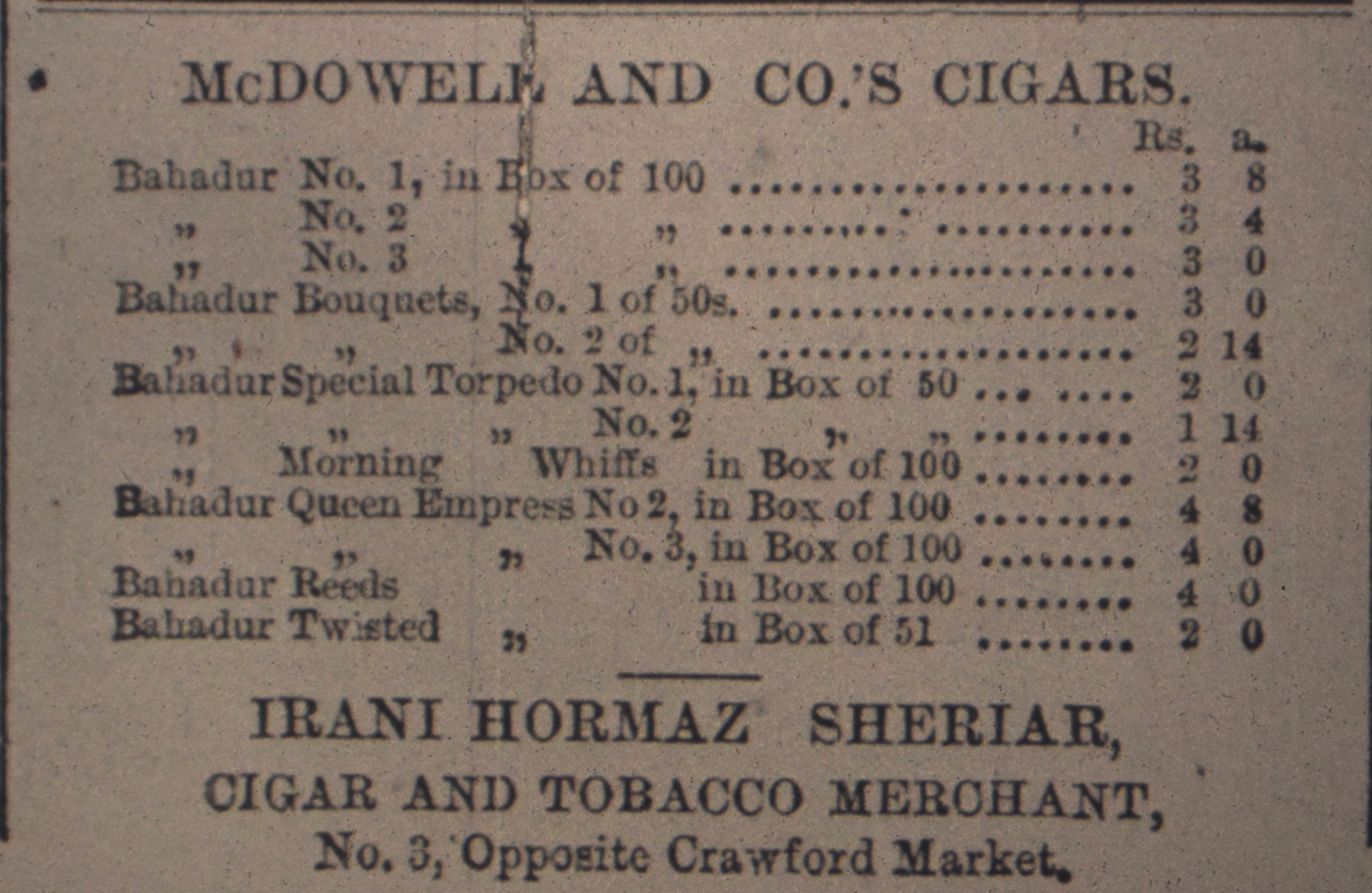
McDowell’s connection with Bahadur is independently visible overseas. A New Zealand advertisement from 1901 named the Anglo-Indian Importing Company as the local agent for “McDowell and Co’s Bahadur Cigars.” By 1921, New Zealand advertisements were still recommending Bahadur alongside Light of Asia and Bouquet.
The McDowell name has an unexpected afterlife. This was not simply an unrelated cigar company that happened to share its name with a familiar whisky. A 1916 Madras High Court judgment described McDowell & Co. Ltd. as Madras general merchants dealing in both tobacco and spirits. The company later established its first distillery in Kerala in 1959 and launched McDowell’s No.1 whisky in 1968. The brand is now part of Diageo India. The old cigar advertisement and the whisky still sold across India belong to the same corporate lineage, even though they come from very different periods of the business.
Here again, names moved between description and identity. Bahadur, a South Asian title associated with bravery or distinction, gave the range an Indian character. Queen Empress pointed in the opposite direction, towards the British Crown. Morning Whiffs promised a moment of use. Reeds, Twisted, Bouquet, and Torpedo suggested form or construction. One catalogue could address several markets at once.
Osborn, Fenn Thompson, and the English name
The surviving record widens again in 1914. An advertisement in the Colonist promoted cigars from the Osborn Cigar Works in Trichinopoly. It listed Flor de Osborn, Gem de Jara, Victorios, Planters, Queen’s Special, Royal Trusts, Ambrosios, Osborn’s Special, Royal Whiffs, Three Minutes, Manilas, and Sumatra Whiffs.
The advertisement called them “Real Indian Cigars,” but also advertised Sumatra leaf, mildness, aroma, and proximity to Havana quality. This was the commercial balancing act. The product needed to be recognisably Indian and internationally legible at the same time.
Names such as Osborn, Fenn Thompson, Hunter, and John Mayer can make the Trichy trade sound like a collection of British-owned firms. At least some were nothing of the kind. V. Vasudevan, the later proprietor of Fenn Thompson, told Firstpost that Solai Thevar founded the company in 1900. He said Indian owners selected English-sounding company names because they sold to British customers. It is an oral explanation given long after the trade’s peak, but it fits the outward-facing language of the surviving catalogues.
Fenn Thompson’s pre-Independence range reportedly included Light of India, Major Coronas, La Corona, and Lady Love. By 2019, the company was still associated with Churchill Special and Black Tiger, though its catalogue and workforce had contracted sharply. In 2004, a report on India’s cigar market identified Java Dawson, Churchill, and Tiger as familiar Trichy names that customers ordered directly by mail.
These later names are important because they connect two worlds. They belong to living memory, but they also echo the earlier system of Coronas, Dawsons, Tigers, Planters, and imperial personalities.
A brief note on Churchill
No history of the Trichy cigar seems able to avoid Winston Churchill. Versions of the story claim that wartime disruption led officials in Madras to send Trichy cigars to London, sometimes through a mysterious “Cigar Assistant.” Later retellings go further and describe the Trichy as a Churchill favourite.
We do not think the evidence supports that stronger claim. It is plausible that Trichy cigars were sent to London or supplied through official and commercial channels. South Indian cigars had an established export trade, and Spencer’s wartime employment increased while it executed war orders. But a shipment, even one intended for government use, would not prove personal preference. The Fenn Thompson account itself acknowledged that its Churchill claim could not be verified.
Until a dated order, letter, invoice, or other primary record establishes the connection, the careful conclusion is simple: cigars may have travelled from Trichy to wartime London, but there is no reliable evidence that Trichy cigars were Churchill’s favourites. The famous version looks more like a good brand story than a settled fact.
What remains after the smoke
The old names are easy to enjoy. Flor de Spencer has elegance. Gold Mohur has weight. Morning Whiffs is charmingly direct. Lady Love, Five Minutes, Catamaran, Light of India, and Queen Empress each opens a small window onto the audience its maker imagined.
But the names also preserve the structure of the trade. Spanish words invoked Havana prestige. Sumatra and Java advertised imported leaf. Corona, Torpedo, and Bouquet organised products by shape or class. British titles and personal names addressed colonial buyers. Indian words and images marked origin. English-sounding companies allowed Indian proprietors to present themselves in a form their export customers recognised.
There may never be a complete catalogue. The 1946 inquiry explains why. Registrations multiplied, identities shifted, and the same cigar could leave the same workbench under more than one name. Boxes were smoked, labels discarded, firms closed, and family records dispersed.
What survives is enough to change the picture. The Trichy cigar was not a single brown roll sold on reputation alone. It was surrounded by a sophisticated culture of naming, grading, packaging, and export. A century ago, buyers did not encounter only “the Trichinopoly.” They chose among Flor de Spencer, Gold Mohur, Bahadur, Planters Special, Dawson, Lady Love, Morning Whiffs, and scores of competitors.
The cigars disappeared. Their names still tell us how a South Indian industry introduced itself to the world.
Further reading
- S. Muthiah, “When the postman knocked,” The Hindu, 29 June 2014.
- “Indian Cigars and Condiments,” Otago Daily Times, 19 January 1895, p. 8.
- “Assorted Case of Spencer’s Finest Indian Cigars,” Otago Daily Times, 9 December 1908, p. 8.
- D. V. Rege, Report on an Enquiry into Conditions of Labour in the Bidi, Cigar and Cigarette Industries, Government of India Labour Investigation Committee, 1946, chapter VI.
- Frederick Edmed Hooper v. King-Emperor, Madras High Court, 28 April 1916. The judgment describes McDowell & Co. Ltd. as dealers in tobacco and spirits.
- “Risen From the Mist: McDowell’s & Co. Reinvents its Legacy,” Diageo India, 2024.
- Advertisement for McDowell & Co.’s Bahadur Cigars, Press, 19 September 1901, p. 3.
- Untitled advertisement, Daily Telegraph, 7 October 1921.
- “Real Indian Cigars,” Colonist, 2 April 1914, p. 2.
- Nikita Doval, “The last drags of a famed Trichinopoly cigar,” Firstpost, 29 March 2019.
- “Indian smokers rapidly graduate to cigars,” Business Standard, 24 June 2004.